Over 50 Years of Experience | We can lift it & shift it!

Crane Wind Speed Limits: When Is It Too Windy to Operate a Crane?
September 30, 2026
Knowing when wind conditions make crane work unsafe is essential for maintaining control, protecting equipment and keeping lifting operations safe. Wind can affect crane stability, load movement and positioning during complex lifts or mining recovery in NSW, where recovery work may involve large, irregular or difficult-to-control loads.
GBP Cranes & Heavy Haulage provides crane hire and recovery services where changing site conditions need to be considered. Wind limits vary on the crane, configuration, load and site conditions, so actual conditions need to be assessed rather than relying on a general wind speed.
The sections below explain what determines crane wind limits, how wind affects different crane types and loads and how conditions can be monitored throughout a lift. They also cover pre-lift checks, changing wind conditions and the warning signs that indicate when lifting operations should be delayed or stopped.
Safe crane wind speed limits are not based on one fixed number. The applicable limit depends on the crane type and configuration, the load being lifted and the conditions at the site. The crane manufacturer's instructions and load charts provide the primary reference for the permitted operating conditions.
Different crane types and configurations have different levels of wind exposure. Boom or jib length, lifting radius, operating height and attachments can all affect the forces acting on the crane. Fly jibs, luffing jibs and other attachments may also have specific wind requirements.
The size, weight and shape of the suspended load can affect its response to wind. Large, lightweight or flat loads such as cladding, formwork, roofing materials and panels can catch the wind and become difficult to control. These loads may require a lower wind limit than the crane's operating limit.
The surrounding site can change how wind affects a crane and its load. Buildings, terrain and temporary structures may create turbulence, channelling or sudden changes in wind direction, while exposed or elevated locations can experience stronger winds. Actual site conditions and wind readings should therefore be considered alongside the manufacturer's specified limits.
Wind places additional forces on both the crane and suspended load. These forces can affect stability, structural loading and load control when the crane is operating at greater height or radius or when the load has a large frontal area.
Wind loading increases as wind speed rises. This is why a relatively small increase in wind speed can have an effect on a crane and its load.
Wind can contribute to:
Large panels, formwork, roofing materials, containers and other high-surface-area loads can be sensitive because they can act like sails. Tag lines and suitable rigging can help manage movement, but they do not remove the effects of strong or changing wind.
There is no single maximum wind speed that applies to every crane operation. The manufacturer's specified limit for the crane and its particular configuration should be treated as the controlling reference. SafeWork NSW advises that crane and lifting operations should stop when applicable manufacturer limits are reached.
As a reference, Queensland's current mobile crane guidance notes that 10 m/s (36 km/h) is specified by a number of manufacturers for some mobile crane loads. However, it also states that the allowable speed may be considerably lower depending on the suspended load and lift configuration.
The measurement used for the limit is also important. Some manufacturer limits are based on maximum wind gusts rather than average wind speed. The Queensland guidance notes that certain crane capacity tables use a three-second wind gust measured at the highest point of the boom.
A wind speed should not be treated as a universal safe or unsafe threshold. The applicable manufacturer limit, actual gust conditions, crane configuration, load characteristics and observed load behaviour all need to be considered before and during the lift.
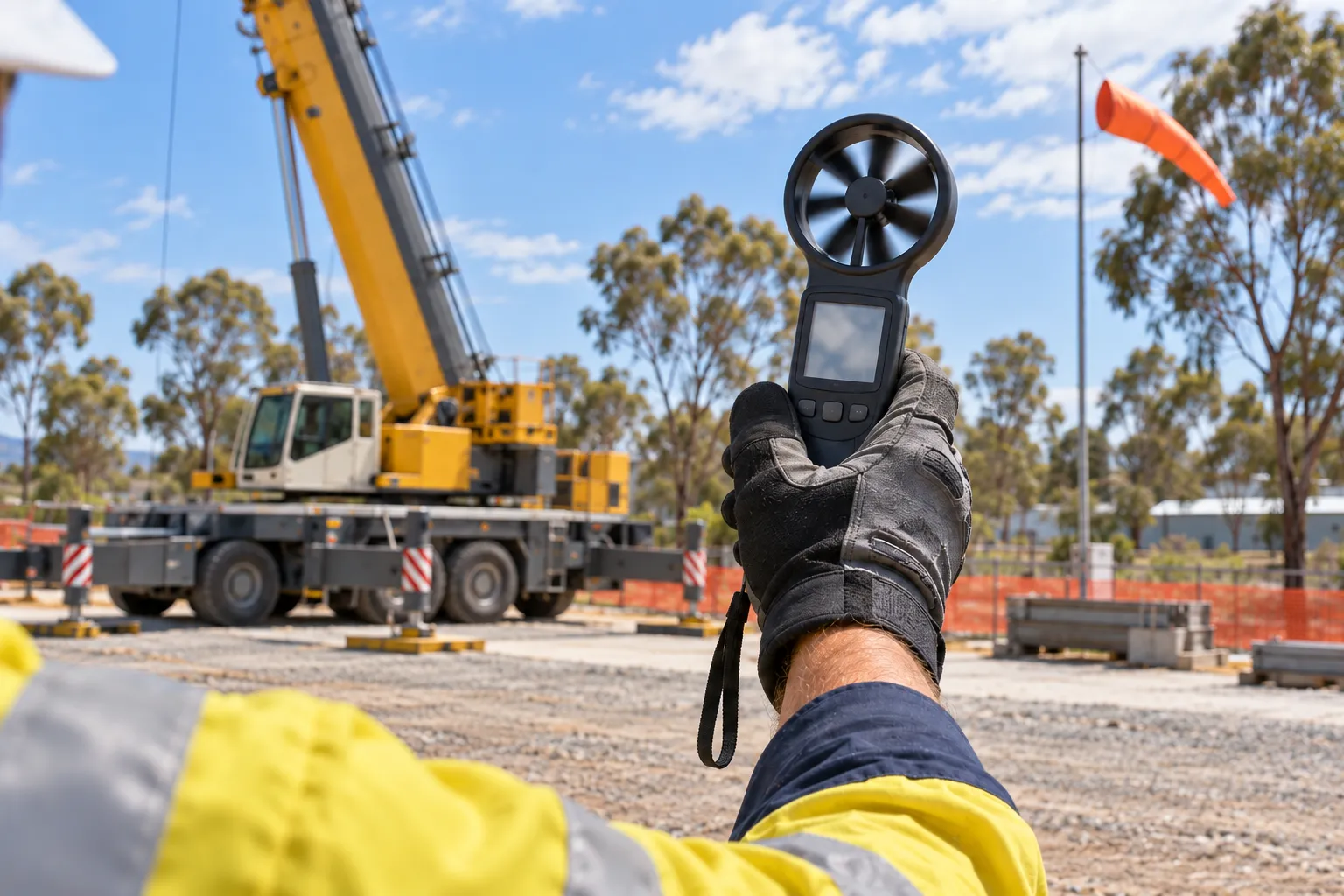
Wind speed on a crane site is measured using an anemometer, providing real-time information about conditions affecting the crane and suspended load. The position of the sensor is important because wind at load height can differ from wind at cabin or ground level. Safe Work Australia specifically notes that boom length and luffing angle can affect the wind experienced at load height.
Consider the following:
Weather forecasts are useful for planning but do not replace real-time site measurements. Actual readings, the manufacturer's requirements and observed conditions should be considered together when deciding whether a lift can safely proceed.
Yes. Different crane types can have different wind limits because their design, boom or jib configuration, size and operating conditions affect their exposure to wind. The applicable limit should always be confirmed from the manufacturer's instructions for the specific crane and configuration.
Mobile cranes with telescopic or lattice booms can experience greater wind exposure as boom height and lifting radius increase. Outriggers, counterweights, ground conditions and the suspended load can also affect the conditions under which the crane can operate safely.
Operators should also consider the effect of wind loading, particularly when handling loads with a large exposed surface area.
Tower cranes have long jibs and often operate at significant heights, exposing them to stronger winds, particularly on exposed or high-rise sites. The wind limits for operating the crane can also differ from those that apply when the crane is secured out of service.
Crawler cranes often use long lattice booms that can present a large surface area to the wind. Wind exposure can become more important during heavy lifts or when the boom is extended, making the specific crane configuration and manufacturer's requirements important.
Attachments like fly jibs, luffing jibs and boom extensions can change the crane's wind exposure and may have specific operating requirements. Any change to the crane configuration should therefore be assessed against the manufacturer's instructions before lifting continues.
Wind limits can also vary according to the load, lifting radius and operating configuration. A limit that applies to a crane without a suspended load should not automatically be treated as the safe limit for a specific lifting operation.
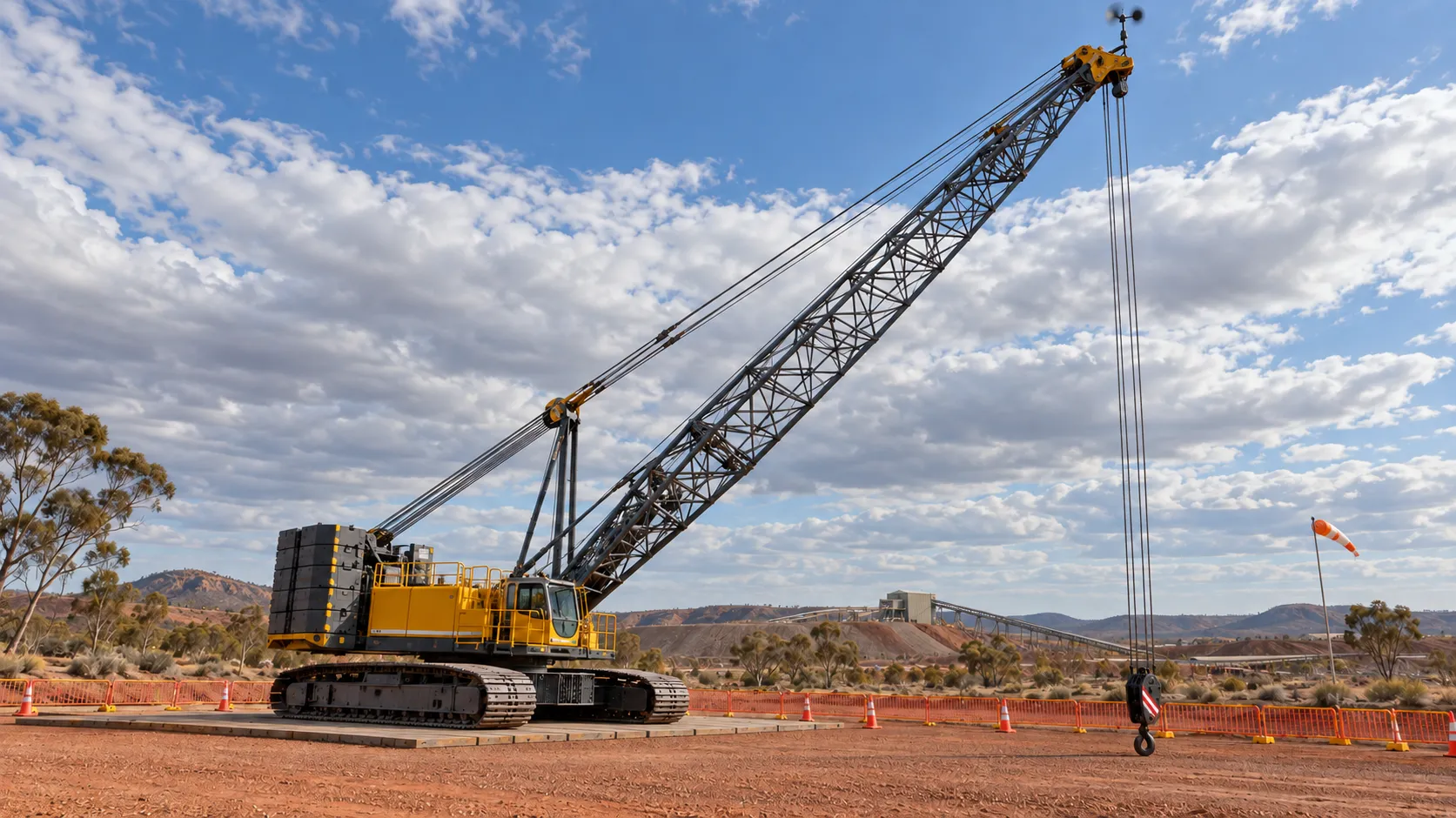
Crane height, boom length and lift radius can increase wind exposure by placing more of the crane and suspended load into stronger or more turbulent conditions. Wind increases with height, while a longer boom or jib increases the exposed area and can place the load further from the crane’s centre of rotation.
Several factors should be considered when assessing wind exposure:
Lift planning should account for the highest operating height and maximum radius rather than relying only on conditions at the start of the lift. Actual wind readings, load behaviour and the manufacturer's specified limits should be considered throughout the operation.
Before starting a lift in windy conditions, operators and lifting supervisors should confirm that the crane, load and site are suitable for the planned operation. The manufacturer's manual and applicable load chart should be checked for the exact crane configuration, boom or jib arrangement, lifting radius and attachments.
Detailed lift planning helps confirm the required crane capacity, configuration, setup area and controls before work begins.
A practical pre-lift check should cover:
A pre-lift assessment should confirm that the crane configuration, load characteristics, wind conditions and site environment remain within the planned operating conditions. If conditions fall outside the manufacturer's requirements or the approved lift plan, the operation should be reassessed before proceeding.
When wind increases during a lift, the operation should be reassessed rather than continuing simply because the lift has already started. Stronger wind can increase side loading and cause the suspended load to swing, rotate or drift, when the load has a large exposed surface area.
The lifting team should assess the current wind conditions and the behaviour of the load. If the load becomes difficult to control, the lift may need to be slowed or paused while the team determines whether it can be safely lowered or moved to a suitable landing area.
If wind reaches or exceeds the manufacturer's specified limit, the lifting operation should stop. The load should be lowered or secured using the procedures established for the crane and lift where this can be done safely and the crane should be secured in accordance with the manufacturer's instructions. Safe Work Australia recommends stopping crane operations when wind exceeds the manufacturer's recommended limit.
The fact that conditions were acceptable at the start of a lift does not mean they will remain suitable. Wind direction, gusts, crane height, boom position and load exposure can all change during the operation.
Wind can make crane recovery and lifting operations more difficult by affecting load control, positioning and equipment stability. Recovery work may involve damaged machinery, vehicles, plant or irregular loads that can behave unpredictably when suspended in exposed locations.
Wind exposure can become more significant when the load is large, lightweight or unevenly shaped, or when the crane is operating at a greater height or radius. Gusts may cause the load to swing, rotate or drift, making precise positioning harder around buildings, infrastructure and other equipment.
During recovery operations, wind conditions should be considered alongside:
If wind increases or the load becomes difficult to control, the recovery operation should be reassessed against the manufacturer's specified limits. The lift may need to be paused, lowered or rescheduled until conditions are suitable.
Crane operations should be delayed or stopped when wind conditions exceed the manufacturer's specified limit or make safe control of the crane or load uncertain. The decision should consider the actual wind conditions, crane configuration, load characteristics and behaviour of the suspended load rather than relying on a general wind-speed figure.
Warning signs that may require the operation to be paused or stopped include:
Proper care is required for loads with a large surface area because they can become difficult to control at lower wind speeds than compact, heavier loads. The Queensland mobile crane guidance notes that allowable wind speeds may be considerably lower depending on the characteristics of the suspended load and the configuration of the lift.
Manufacturer wind limits should be treated as operating boundaries rather than targets. Where conditions are approaching the specified limit or the load is becoming difficult to control, the lifting team should reassess the operation and determine whether it is safe to continue. If the lift is stopped, the crane and load should be secured in accordance with the applicable manufacturer's procedures.
Managing wind during crane operations involves more than checking a weather forecast before a lift. Manufacturer wind limits, crane configuration, load characteristics, lifting radius and actual site conditions all need to be considered, with wind speed and gusts monitored throughout the operation.
GBP Cranes & Heavy Haulage takes these factors into account when carrying out crane lifting and recovery work. If wind conditions approach or exceed the specified operating limits, the lift can be reassessed, delayed or stopped as required. Careful planning and ongoing monitoring help keep loads under control while protecting personnel, equipment and surrounding property.
